
What is the most common mistake in Detective Duck?
Accusing the suspect who looks most obviously guilty instead of the one the evidence actually points to — several cases are built around this exact trap, and track a wrong-accusation badge for it.

Detective Duck tips: search every room before touching a lock, weigh motive and opportunity before you accuse, split co-op roles, and avoid a wrong vote.
The tutorial Apartment case is the clearest example of the search-then-match habit every tip on this page is built around.
~7 min read
Every Detective Duck case runs the same investigation spine — search, solve locks, review suspects, accuse — and almost every mistake new detectives make happens at one of those four steps. This page collects the habits that fix them, gathered across cases rather than tied to any one map.
| Fact | Detail |
|---|---|
| Players | Solo or co-op up to 5 (private servers up to 10) |
| Timer | No strict timer confirmed on most cases — evidence quality matters more than speed |
| Core tools | Case File, Phone, Magnifying Glass, and case-specific items (UV light, keycards) |
| Wrong accusation | Tracked per case with its own badge, so a bad guess is recorded, not just reset |
Most puzzle codes and suspect evidence hide in things you can read, not things you have to guess — which means a slow, complete first pass through a scene beats a fast, partial one every time.
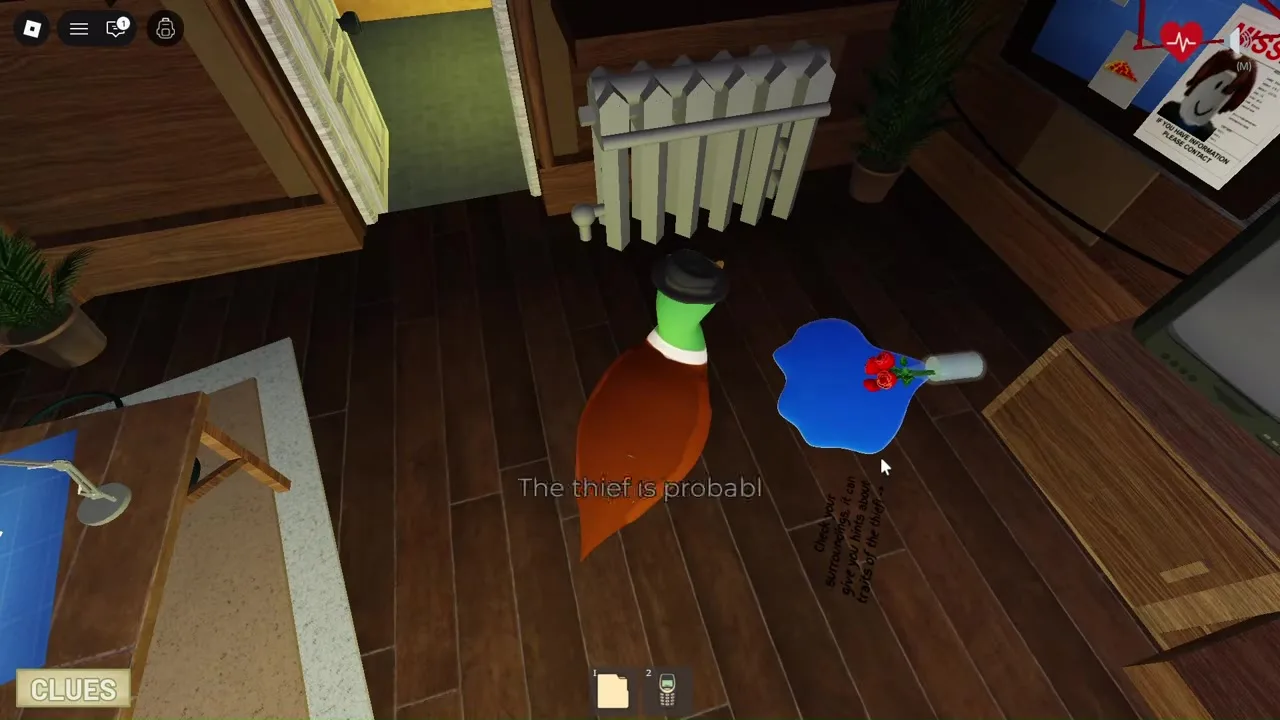
Most evidence pop-ups describe a physical trait or habit — "the thief is probably a messy person," "black hair on the floor" — rather than handing you a suspect's name outright. Treat each one as a filter: cross it against the suspect list in your Case File and narrow from there instead of waiting for the game to spell out the answer.
Each case gives you a short suspect list with a role and a statement in the Case File. The correct suspect is the one whose statement or alibi contradicts the physical evidence you actually collected — not simply the person who looks most suspicious at a glance.
| Signal | What it means |
|---|---|
| Statement contradicts a record | A check-in log, timestamp, or document disagrees with what the suspect claims — strong evidence |
| Suspect matches a physical trait | Hair color, clothing, or an item (hat, tool) recovered at the scene matches one suspect specifically |
| Suspect "looks" guilty but has no access | A common frame-job pattern — the person with means and opportunity is often not the obvious one |
| Confused or inconsistent reaction | Innocent suspects framed by evidence often show confusion rather than a clean explanation — that is itself a clue |
Only submit through the phone's "End Investigation" option once the evidence explains both motive (why this person) and opportunity (how they could physically do it). A suspect who fits one but not the other is usually the case's intended red herring.
Several cases track a dedicated wrong-accusation badge per map, so a bad guess isn't just a quiet retry — it's logged. If you're unsure, re-open the Case File and re-read every statement once more before you vote rather than accusing to "see what happens."
Solo, that re-check is on you alone. In a group, it's exactly the kind of thing a second player should be doing in parallel — which is where co-op role splits pay off.
Matched by build plan, shared topics, and guide progression — not random related links.
Solo or co-op up to 5 (private servers up to 10). A group that splits roles clearly solves a case faster than the same group all clicking through the same rooms together.
Private servers support up to 10 players, which is enough to split a large case into two or three parallel search zones. Beyond that, coordination overhead usually costs more time than the extra hands save — smaller focused groups tend to out-pace larger uncoordinated ones.
Detective Duck is built to be mobile friendly, but small touchscreens make two specific mistakes far more common than they are on PC.
Handwritten digits on notes and keypads are easy to misread on a phone screen, and a mistyped digit on a touch keypad reads as a wrong code rather than a broken one. Pinch-zoom on any document or lock before committing to a number.
Suspect photos and statement text sit close together in the Case File UI on small screens — tap the portrait or the statement text specifically rather than tapping near the edge of a card, which can select the wrong entry.
Use this as a pre-vote checklist. It maps the failures that repeat across cases to their fix, so you can scan it instead of re-reading the whole page mid-session.
| Mistake | Fix |
|---|---|
| Trying a lock before finding its clue | Search the full room first — codes are earned from evidence, not guessed by brute force |
| Skimming a note instead of reading it fully | A name, date, or number is often buried mid-paragraph, not in the first line |
| Accusing the "obvious" suspect | Cross-check motive and opportunity against the evidence — several cases are built to frame the obvious pick |
| Re-searching a room a teammate already cleared | Call out cleared rooms in co-op so effort isn’t duplicated |
| Mistyping a keypad code on mobile | Zoom in before tapping digits — see the mobile section above |
| Trusting an unverified code from another site | Cross-check against the codes page before typing anything into a lock |
| Voting before checking the full suspect list | Review every suspect’s statement once more, not just the one you already suspect |
Before you open the phone to end the investigation, ask yourself whether you could explain the accusation to someone who hasn't played the case: what evidence, what motive, what opportunity. If you can't answer all three in one sentence, you're not ready to vote yet.
Accusing the suspect who looks most obviously guilty instead of the one the evidence actually points to — several cases are built around this exact trap, and track a wrong-accusation badge for it.
No — there is no strict timer confirmed on most cases, so take the time to read every clue fully before opening locks or voting.
Both work — solo play is fine since there's no timer pressure, and co-op up to 5 (10 on private servers) speeds up large cases if you split search, Case File, and code-tracking roles.
Open the cases hub and pick the case you're stuck on for its key evidence and confirmed suspect.
The codes page lists confirmed in-game puzzle codes cross-referenced by case — motel, bank vault, jewelry, train, and more.
Google often shows the codes hub for “motel code” / “bank vault code” queries. Use that hub’s FAQ jump links, or open the matching case page for the full clue path.
Matched by build plan, shared topics, and guide progression — not random related links.